
The Employee Manual
The Failure Mode I Brought to the Café and What It Taught Me About Working With Anyone, Including AI

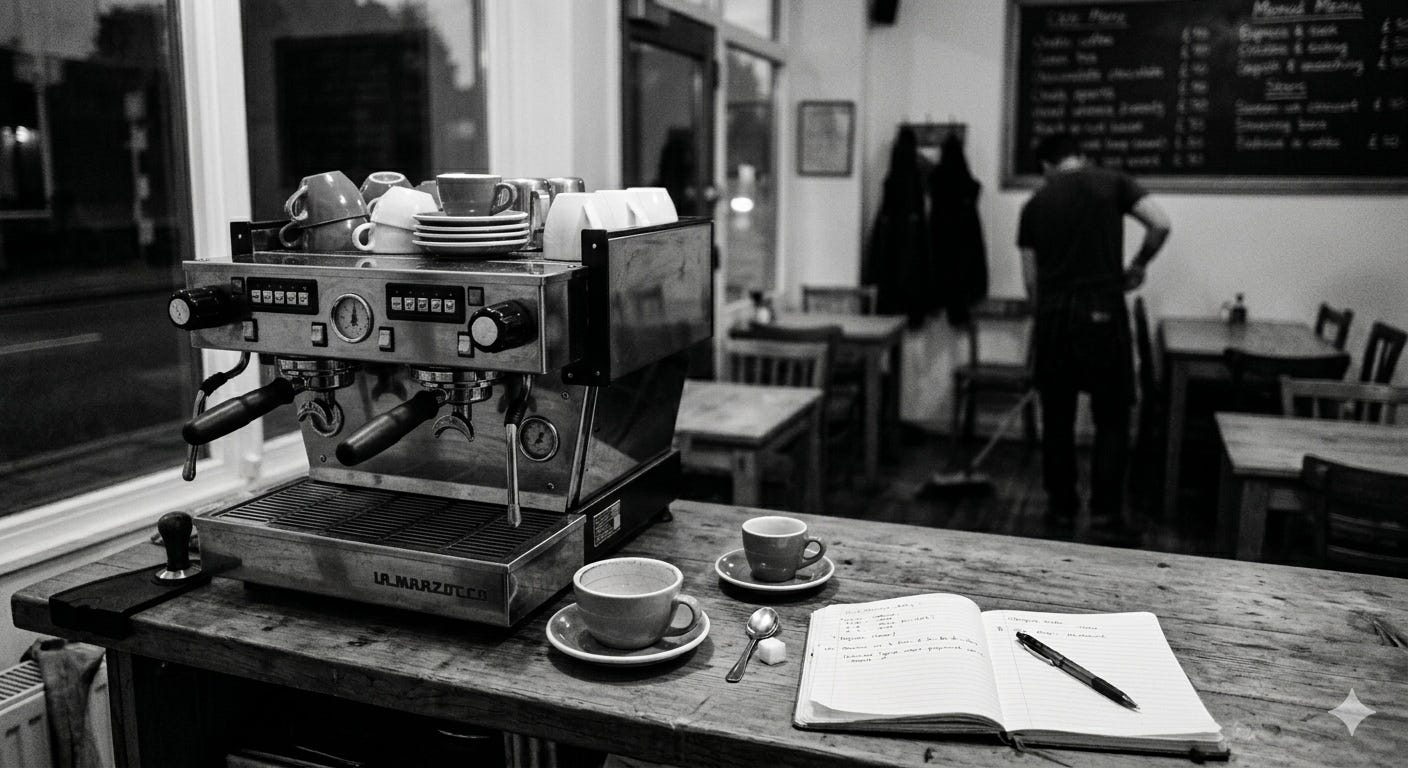
I owned a café in Pacifica for eight years. The Beach Monkey Organic Café. Small operation, at its peak twelve employees, mostly part-time, always turning over.
One of the first things you learn when you run a place like that is that you cannot, no matter how much you want to, do every job yourself.
I tried.
I was not good at delegating. Growing up my brothers and I learned to ‘figure it out.’ I brought that mentality to the café. It failed almost every time. ‘Figure it out’ works between people who already share the language. Said to a new employee, it sounds like impatience or contempt.
You will train someone to make coffee, and they will make coffee. They will not make it the way you would make it. They will make it the way they understood you to mean when you trained them. The gap between those two things is your management problem.
The message underneath ‘figure it out’ is ‘I don’t have time for this.’ And it escalates fast — first to ‘why can’t you do this right?’ Then to ‘why can’t you do anything right?’ My skeletons invade the skeletons of the people I work with.
Figuring it out is a real skill. It builds independence, critical thinking, problem-solving. The trouble is what happens when you ask someone to do it without giving them the foundation. They don’t hear ‘I trust you to work this out.’ They hear ‘I’m too busy for you.’ A skill becomes a wound.
The Manual as Protection
Eventually I learned that a manual is what helps fill the gap. Not because process is more important than judgment, but because process is what protects the new employee from your impatience.
That sentence is the one that took me years to understand.
I used to think of operating manuals the way most small business owners do — as bureaucracy, as friction, as the thing real operators don’t need. Real operators figure it out. The manual is for people who can’t.
I had it backwards.
The manual isn’t there because the new employee can’t think. It’s there because I can’t be patient. The manual is what protects the operator from the failure mode I bring into the room. When I write down ‘espresso pulls in 22 to 28 seconds’ or ‘till gets counted twice at close, by two people, and the numbers have to agree before either of you leaves,’ I’m not constraining the employee’s judgment. I’m preventing myself from the conversation that starts with ‘why didn’t you’ and ends with the new hire never coming back.
The manual is what makes delegation possible without abandoning standards. Without it, every shift turns into me checking work I should be trusting, and the operator slowly internalizing that they are surveilled rather than supported. With it, the operator has clear ground to stand on, and I can sleep when someone else is closing the till.
It took me three years to understand this. I had an employee manual from day 1. I didn’t understand what it meant until three years later.
The Pattern Shows Up Again
This morning I was building a structured set of files for an AI trading bot I’ve been running. The files are for a knowledge base — context an AI agent reads at the start of every session so I don’t have to re-explain the project every time. Standards. Operating principles. Role definitions. What each agent can do and not do.
I was three hours in when I realized what I was actually building.
It wasn’t a knowledge base. It was an employee manual.
The structure was identical to what I wrote for the café. There was a universal section that applied to everyone — the standards, the values, the non-negotiable rules. There were role-specific sections that built on top. There were operating rules that were strict on purpose because looseness corrupts the work.
But the realization underneath was the harder one. The reason I was writing it now, the reason I was three hours into building infrastructure I hadn’t built for the first 25 days of the experiment, was the same reason I’d written the café manual.
I was protecting the operator from my own impatience.
When I work with an AI agent without a manual, I do the same thing I did to the new baristas. ‘Figure it out.’ ‘You should know this.’ ‘Why can’t you remember what we just talked about.' The fact that the AI has no memory across sessions doesn’t change my reflex — it just makes the reflex more visible. The frustration was always mine. The infrastructure had always been the answer.
The skeletons that invade the skeletons of the people I work with are mine. They were mine at the café. They are mine now. The manual brings awareness to my shortcomings. And that awareness helps me work better with the people around me. Including AI.
What the Cafe Years Were Actually Teaching
I used to tell people the café taught me business. Cash flow. Inventory. Hiring. The mechanics of running a small operation. All of that is true.
But the deeper lesson — the one I’m still working out — was about myself. About what happens when I’m under pressure and someone needs my patience. About the gap between what I say and what the new employee hears. About the difference between ‘figure it out’ as a skill I want to encourage and ‘figure it out’ as the sound of me checking out of the relationship.
The manual was the answer to a question I didn’t know I was asking. The question was: how do I get out of my own way?
You can’t fix the impulse by deciding to be more patient. The impulse comes from somewhere old and it doesn’t respond to instruction. What you can do is build infrastructure that intercepts the impulse before it lands on the person across from you. Write the rule down. Let the rule do the work. The rule is more patient than I am.
The MFA in writing was supposed to make me a writer. The kinesiology degree was supposed to make me a healthcare professional. The café was supposed to be a small business that paid the bills while I figured out the rest.
None of those careers turned out the way I planned.
But the writer learned to revise drafts until they were right. The kinesiologist learned to think about systems and feedback loops. The café owner learned that the failure mode he brings into the room is his problem to solve before it becomes someone else’s wound.
Put those three together and you have someone who knows how to build infrastructure for collaboration that doesn’t depend on him being a better person than he actually is on any other day. But it opens the door for someone to become a better person than who they are.
That’s the credential. Not the writing, not the kinesiology, not the café. The thing that came out of running through all three and noticing what kept failing in the same way.
The manual works.
I love this post! You're doing the difficult job of self-actualization and I am privileged to learn more about myself through your posts. Thank you!